








ETH Staking with P2P.org Is Now Live in Ledger Enterprise
Treasury ETH can now earn staking rewards through the same approval, governance and signing controls clients already use for custody.
Ledger Enterprise clients can now stake ETH with P2P.org, joining SOL, XTZ and ADA. Treasury ETH can earn staking rewards without leaving the approval, governance and signing controls clients already use for custody.
How it works
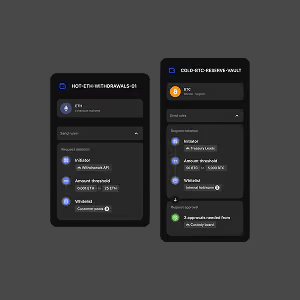
Clients choose a P2P.org validator inside Ledger Enterprise and approve the stake through the same workflow they use for every other transaction. The governance rules their administrators have set still apply, including approval quorums, limits and whitelists. Once the required approvals are in, the deposit is signed automatically with the client’s keys inside certified hardware security modules. The keys never leave Ledger Enterprise.
P2P.org runs the validators. Withdrawal credentials point to the client’s own address, so staked ETH and rewards can only be withdrawn back to the client.
Why the custody layer matters for staking
A staking deposit is a transaction like any other, and it carries the same risks: a manipulated approval, a changed rule or a compromised key. In Ledger Enterprise, operators approve on Personal Security Devices with a trusted display, so what they see is what they sign. Without that, an approval shown on a laptop or phone screen can be spoofed, and teams end up authorising a transaction that isn’t the one they reviewed.
Governance rules can only be changed by the client’s own administrators through a quorum. Signing happens inside certified hardware, and Ledger has no access to client keys. ETH staking runs inside all three layers from day one.
Pectra support
The integration supports Pectra, the Ethereum upgrade that raised the maximum balance a single validator can hold from 32 ETH to 2,048 ETH. For institutions staking larger positions, that means far fewer validators to monitor and reconcile.
Built with P2P.org
P2P.org staking has run on Ledger Wallet since mid-2025, and in Ledger Enterprise for SOL, XTZ and ADA since earlier this year. P2P.org secures over $10B in institutional assets across 35+ proof-of-stake networks. It has a record of zero slashing incidents to date, meaning the network has never penalised client stake for a fault by a P2P.org validator. It also holds SOC 2 Type II attestation and is certified to ISO/IEC 27001:2022.
“Our clients want to put their ETH to work without adding a new signing process to their custody setup. With P2P.org, staking runs through the same approval, governance and signing controls they already use in Ledger Enterprise.”
[Name], [Title], Ledger Enterprise
Getting started
Existing Ledger Enterprise clients can enable ETH staking with P2P.org through their account team. Institutions evaluating custody with staking in scope can talk to our team about a pilot.
[CTA button: Talk to our team]
For the technical detail on P2P.org’s validator infrastructure, read P2P.org’s full breakdown.
About Ledger Enterprise
Ledger Enterprise is the self-custody and key management platform that funds, exchanges and asset managers use to secure and operate digital assets. It’s trusted by 70+ institutional clients and backed by Ledger, which secures 20% of the world’s crypto value and has had zero security breaches since 2019.
Disclaimer: Rewards are not guaranteed. Ledger does not provide financial advice. This content is for informational purposes only. Staking involves risks, including slashing and withdrawal delays. Validator services are provided by P2P.org, and Ledger does not operate validators. [Legal to review]