








How Ledger Enterprise Unlocks True Institutional Self-Custody For Canton Network
Ledger's hardware-enforced threshold strategy mitigates single-validator risk, enabling secure institutional adoption of Canton's decentralized capital markets.
How Ledger Enterprise Unlocks True Institutional Self-Custody For Canton Network
In the race to digitize capital markets, financial institutions are demanding infrastructure that meets the highest standards for privacy, compliance, and, crucially, security. The Canton Network, a landmark initiative in institutional decentralized finance (DeFi), has provided the rails. Now, Ledger Enterprise is delivering the missing piece of the puzzle: a truly self-custodial solution that mitigates a core security vulnerability inherent in the network’s architecture.
The introduction of Ledger Enterprise’s Canton support, built on a unique hardware-enforced threshold scheme, establishes a new benchmark for securing institutional digital assets on Canton Network.
Canton Network: The future of Institutional Finance
The Canton Network is a public permissionless L1 specifically designed for regulated financial institutions, with no KYC to join or build on the network. Backed and used by major financial institutions, as well as leading names in institutional crypto, it serves as a "network of networks," connecting independent applications and ledgers into a cohesive, interoperable ecosystem.
Who is Canton for?
Canton is purpose-built to serve capital markets, global banks, asset managers, and other major regulated financial institutions.
What Are Canton’s Key Features?
- Privacy by Default: Unlike public blockchains, transaction data is shared only on a "need-to-know" basis, ensuring commercial and regulatory confidentiality.
- Institutional-grade interoperability: Enables atomic settlement and digital asset mobility across different applications and ledgers on the network.
- Use cases: The Canton Network’s infrastructure makes it particularly well-suited for tokenized Real-World Assets (RWAs) like bonds and funds, collateral mobility, and instant payment-versus-payment (PvP) workflows.
All in all, the Canton Network’s design makes it ideal for compliant, secure, and highly efficient market operations.
The Critical Custody Challenge: Validator Risk
While the Canton Network offers exceptional privacy and control features, because of its unique use of stakeholder nodes (validators) to maintain these capabilities, its native wallet structure presents unique risks that institutional asset managers should understand and address.
On Canton Network, a user's wallet (referred to as a "party") is most often linked to a single validator node, which hosts and manages it.
As a result of this framework, the operator of this single, hosting validator node has control over the underlying infrastructure and software. This level of access means that they could theoretically change local parameters on their node to bypass standard controls. For example, this could allow the operator to unilaterally approve malicious transactions and render digital assets unusable.
For institutions managing billions in digital assets, this is obviously a non-starter. Fortunately, Ledger has addressed this risk.
Ledger Enterprise’s Advanced Mitigation Strategy
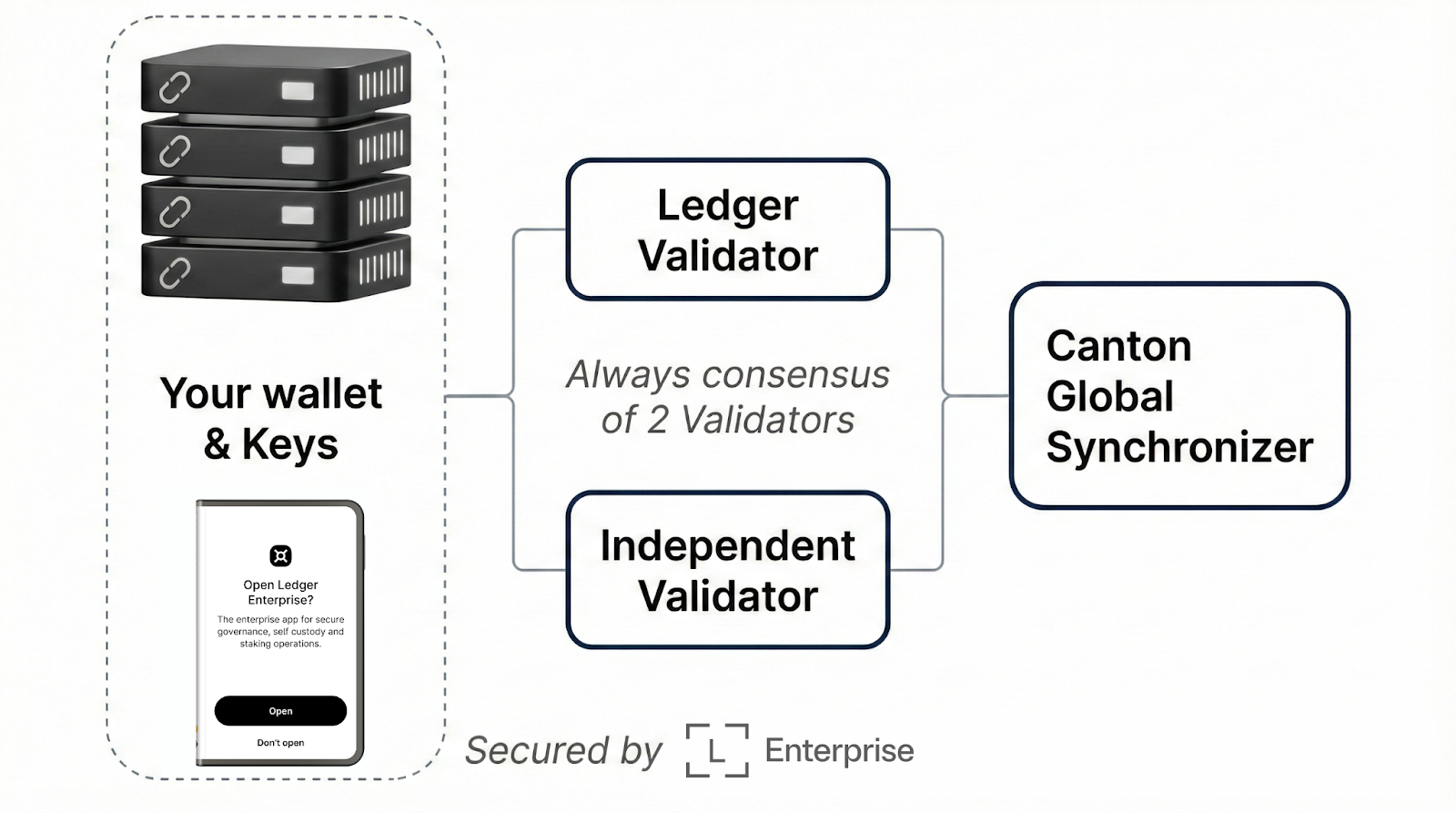
Ledger Enterprise has developed an industry-leading security architecture that stays true to the principle of true self-custody by separating the control of the digital asset from the single validator operator:
- The Threshold Approach
Instead of relying on a single validator, Ledger implements a multi-validator setup with a threshold requiring at least two validators to confirm transactions. This means that for any transaction to be signed and validated, the required multi-signature threshold must be met by the cryptographic confirmation of multiple, independent validators. Ledger also enforces the use of external parties to sign submitted transactions.
- Hardware-enforced policy and Firmware upgrade
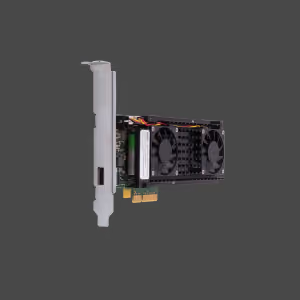
Ledger’s innovation goes beyond this multi-validator setup coupled with a threshold mechanism. The threshold mechanism is also enforced at the signer level, implemented in Ledger HSMs (Hardware Security Modules) and Ledger PSDs (Personal Security Devices) using Ledger hardware and firmware. This means the cryptographic rule for multi-validator signing is embedded at the deepest hardware and software layer of the key management system.
By enforcing the threshold check in the hardware, Ledger mitigates the risk that a malicious or compromised validator operator could change threshold parameters at the validator level to bypass the security policy.
This layered security approach, enforced at the hardware level, is one-of-a-kind in the industry, making Ledger Enterprise a premier provider delivering an institutional-grade, genuinely self-custodial solution for Canton digital assets by mitigating the single-validator risk.
Executive Insight and Vision
This integration marks a critical step toward mainstream institutional adoption of decentralized capital markets.
“Custody must evolve to match the complexity of modern networks. Ledger’s unique, hardware-backed threshold strategy for Canton doesn’t just secure the digital assets; it secures the institutional trust model by mitigating a fundamental, systemic risk,” says Sébastien Badault, VP Enterprise at Ledger.
“Canton is built on the premise of secure, private interoperability, but that foundation demands leaders in the ecosystem to help maintain this promise end-to-end, with best-in-class solutions for the network. By implementing this robust security layer, Ledger Enterprise supports global institutions to confidently expand from their initial trades on Canton to full-scale deployment on the network,” states Eric Saraniecki, Co-Founder of Digital Asset and Canton Network.
Understanding Ledger Enterprise
Ledger Enterprise is a turn-key, end-to-end digital asset management platform for institutions. It provides a Software-as-a-Service (SaaS) operational layer built on Ledger’s core security technology.
Who is it for?
Ledger Enterprise serves Banks, Custodians, Asset Managers, Crypto Asset Service Providers (including Crypto-exchanges), and corporations.
Key Features of Ledger Enterprise:
- Self-Custody: Clients retain full control and ownership of their private keys, which are secured in FIPS 140-2 Level 3 certified Hardware Security Modules (HSMs).
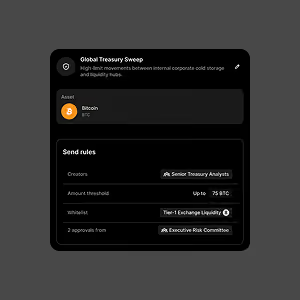
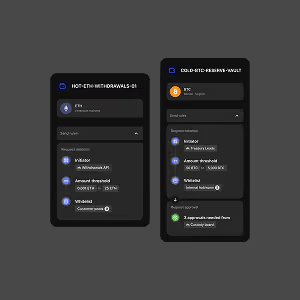
- Governance and Control: Provides a robust, fully auditable operational framework with customizable, multi-authorization workflows (e.g., spending limits, withdrawal delays, quorum requirements).
- Scalability: Allows institutions to securely manage a vast portfolio of digital assets across multiple blockchains at an enterprise scale.
By extending its Enterprise security model to the Canton Network, Ledger Enterprise is directly enabling traditional finance to participate in the new era of decentralized capital markets without compromising on security or control.
Want to learn more about Ledger Enterprise? Request a call with our team.


.png)