








Post-Quantum Crypto Custody: HSM vs MPC and How Banks and Institutions Can Prepare
Quantum computing is still an emerging technology, but its potential impact on digital asset security is already raising important questions for banks, exchanges, and other financial institutions.
As blockchain networks begin preparing for post-quantum cryptography, institutions will need to consider whether the security architecture they choose today can adapt to the standards of tomorrow.
This piece covers what quantum computing could change for digital asset custody, how HSM and MPC architectures may respond, and what readiness looks like for institutions preparing today.
What is quantum computing?
Quantum computers use quantum-mechanical properties to solve certain types of mathematical problems differently from conventional computers. For digital assets, the relevant question is what that capability could mean for the public-key cryptography that secures blockchain transactions today. [1]
This does not mean current blockchains are at immediate risk. The concern is future migration: as post-quantum cryptographic standards mature, blockchain networks and the infrastructure supporting them will need to adapt to new ways of signing and verifying transactions.
What does quantum computing mean for digital asset custody?
Quantum computing could eventually make some of the public-key cryptography used by blockchain networks vulnerable, requiring networks and the custody infrastructure supporting them to adopt new cryptographic standards.
Many blockchains rely on digital signatures to prove ownership and authorize transactions, so the implications for custody extend beyond the algorithm itself. Private keys sit at the center of transaction authorization, while institutional custody also depends on the systems around them: how keys are generated and protected, how transactions are approved, and how policies are enforced.
As blockchain networks move toward post-quantum cryptography, different networks may adopt different signature schemes and migrate on different timelines. Financial institutions cannot control those choices, but they can consider whether their own custody infrastructure is capable of supporting new cryptographic standards as they emerge.
Timing matters because institutional custody systems can take years to design, deploy, and integrate. Infrastructure being selected today may still be in use when post-quantum migration begins.
The pressure is not only technical. Governments and standards bodies are also setting expectations around post-quantum migration. The EU's coordinated roadmap calls for Member States to begin the transition by the end of 2026, migrate high-risk use cases by the end of 2030, and complete the transition for medium- and low-risk use cases as far as feasible by 2035. [2]
In the US, post-quantum migration is now federal policy for government systems. Executive Order 14412, signed on June 22, 2026, requires high-value assets and high-impact systems to adopt post-quantum key establishment by the end of 2030 and post-quantum digital signatures by the end of 2031. OMB Memorandum M-26-15, issued two days later, turned these deadlines into an operational roadmap, requiring agencies to submit migration plans within 120 days. [3]
For institutions operating infrastructure with long deployment and replacement cycles, those timelines add another reason to consider post-quantum readiness before migration becomes urgent.
This puts crypto-agility at the center of the discussion: the ability for cryptographic infrastructure to evolve as standards and blockchain networks change. [4]
HSM vs MPC: which is better positioned for post-quantum custody?
Neither MPC nor HSM architecture is inherently post-quantum resistant. The difference lies in how each model may adapt when blockchain networks begin adopting new post-quantum signature schemes.
Multi-Party Computation
Multi-Party Computation, or MPC, distributes signing authority across multiple participants or systems, allowing them to produce a valid transaction signature without a complete private key being held in one place. It has become a widely used approach to institutional digital asset custody.
Post-quantum migration could introduce new complexity to that model. MPC protocols are built around the mathematical structure of the signature scheme they support, and some post-quantum schemes may not work efficiently with the same distributed signing techniques used today. Hash-based signatures, for example, can be particularly difficult to adapt to MPC, meaning a custodian may need a new signing protocol or a different architecture rather than simply switching to a new algorithm.
Yehuda Lindell, Head of Cryptography at Coinbase, has discussed the possibility that some post-quantum signature schemes could be incompatible with MPC. Coinbase, whose core custody architecture uses MPC, is therefore also exploring programmable HSMs as a fallback for future schemes that may not work effectively within an MPC model. [5]
Hardware Security Modules
HSM-based architecture takes a different approach. A Hardware Security Module protects cryptographic keys and signing operations within a secure hardware environment.
HSMs are not automatically quantum-resistant either. Their relevance to post-quantum readiness comes from programmability: as blockchain networks adopt new cryptographic standards, a programmable HSM may be able to support new algorithms within the existing hardware security boundary.
A blockchain becoming post-quantum resistant does not automatically make the custody infrastructure connected to it post-quantum ready. If a network introduces new key types, signature schemes, or transaction requirements, custody systems must also be able to support those changes.
Supporting a new signature scheme through MPC requires a practical distributed implementation of that specific scheme. With programmable secure hardware, the new cryptographic operation may instead be introduced within the existing HSM environment. The difference could affect how readily each architecture can respond as blockchain networks migrate to post-quantum cryptography.
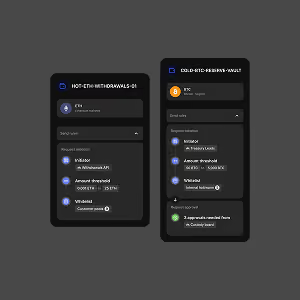
This architectural question applies directly to Ledger Enterprise, where private keys never leave the HSM and the HSM secures the governance rules that approve each transaction.[6] How new signature schemes would be introduced into that boundary is a question institutions should put to every provider, Ledger Enterprise included.
As cryptographic requirements evolve, institutions will need custody infrastructure that can support those changes while maintaining the security, governance, and approval controls they already rely on. The question is therefore not whether one architecture is already “quantum-proof,” but how effectively it can adapt when the networks it supports begin to change.
How can banks and institutions assess their post-quantum custody readiness?
Post-quantum readiness is not a single product feature or certification. For banks, exchanges, and other financial institutions, it means understanding how well existing custody infrastructure can respond when blockchain networks begin changing the cryptography used to authorize transactions.
A useful starting point is to assess where cryptographic change would affect the current custody model, and how much of the infrastructure would need to change with it.
Institutions can begin by asking:
Can the custody architecture support new cryptographic algorithms?
If a blockchain adopts a new post-quantum signature scheme, the infrastructure securing and signing transactions needs a viable path to support it.
Can different cryptographic standards be supported at the same time?
Blockchain networks are unlikely to migrate on one coordinated timeline. Institutions may need to operate across existing and post-quantum standards simultaneously.
What would post-quantum migration actually require?
Supporting a new signature scheme should be considered in terms of systems, hardware, integrations, and operational processes. Institutions should understand whether an upgrade can be introduced within the existing architecture or whether significant rebuilding would be required.
Can governance remain consistent throughout the transition?
Changes to cryptography should not mean losing established controls around transaction approval, access, and policy enforcement.
How will security be maintained during migration?
Institutions should understand how keys, signing operations, and transaction workflows remain protected while new cryptographic standards are introduced.
Is there a clear roadmap for post-quantum support?
Custody providers should be able to explain how they are evaluating emerging standards, how new algorithms would be tested, and what their migration approach is likely to involve.
The path to post-quantum custody will depend on the choices blockchain networks make and the ability of custody providers to support them. Banks, exchanges, asset managers, and other institutions can prepare now by assessing their cryptographic dependencies, testing providers' migration assumptions, and making adaptability a requirement in infrastructure decisions.
For institutions evaluating Ledger Enterprise, that means examining how hardware-based key protection and governance can be maintained as signing requirements evolve. A credible migration path should explain how new cryptography will be introduced, validated, and operated while preserving the controls institutions rely on today.
Building crypto-agility into custody planning now can give institutions more options, and more time to act, as blockchain networks move toward post-quantum security. One question cuts through most of it: if a network you support adopted a new signature scheme next year, what would your custody provider actually have to change?
If you’re interested in learning more about Ledger Enterprise, contact us here
Sources
- NIST, Post-Quantum Cryptography
- European Commission, A Coordinated Implementation Roadmap for the Transition to Post-Quantum Cryptography
- The White House, Executive Order 14412: Securing the Nation Against Advanced Cryptographic Attacks (June 22, 2026); Office of Management and Budget, Memorandum M-26-15: Execution of the Migration to Post-Quantum Cryptography (June 24, 2026)
- NIST Computer Security Resource Center, Crypto Agility
- MARA Foundation TV, Coinbase's Plan for Post-Quantum Custody with Yehuda Lindell
- Ledger Enterprise, Keep Your Signing Keys On-Premise Without Giving Up Modern Custody (July 13, 2026)