









Ledger Enterprise Joins Supporter Coalition for Ethereum Institutional
Ledger is joining 100+ ecosystem supporters backing Ethereum Institutional, the independent non-profit accelerating institutional adoption of Ethereum.
Ledger Joins Supporter Coalition for Ethereum Institutional
Excerpt: Ethereum Institutional has closed its initial ecosystem funding round, alongside a broad coalition of 100+ ecosystem supporters. Ledger is among them, reflecting its commitment to providing secure infrastructure for institutional ownership of digital assets.
Before You Dive In:
- Ethereum Institutional is an independent non-profit dedicated to accelerating institutional adoption of Ethereum, backed by 100+ ecosystem participants and anchored by Joe Lubin, Mihai Alisie, Bitmine, and Sharplink.
- Ledger Enterprise provides the institutional custody infrastructure institutions need to deploy on Ethereum with confidence: Hardware Security Module-backed security, hardware-enforced governance, and Clear Signing for human-readable transaction verification.
- Clear Signing, pioneered by Ledger and now stewarded by the Ethereum Foundation as an open Ethereum standard, addresses one of the most consequential risks institutions face when moving capital on-chain: approving transactions they cannot read or verify.
Institutional adoption of Ethereum is no longer a question of whether. Tokenization, stablecoins, and on-chain market infrastructure are moving from concept to deployment across banks, asset managers, and sovereign institutions. The question now is whether the ecosystem around them is ready.
Ethereum Institutional exists to help answer that question. Launched in July 2026 as an independent non-profit, it serves as a neutral, ecosystem-aligned counterpart for institutions evaluating how to build on Ethereum and its broader ecosystem. Rather than competing with the teams building across the space, it works alongside them: surfacing institutional requirements, supporting real deployments, and helping connect institutions with the right expertise.
Ethereum Institutional Closes Initial Ecosystem Funding Round
Today, Ethereum Institutional announces the close of its initial ecosystem funding round, anchored by Bitmine, Sharplink, Ethereum co-founders Joe Lubin and Mihai Alisie, alongside a broader group of crypto-native institutions and individuals. More than 100 ecosystem participants have joined as supporters, each contributing capital, time, expertise, or amplification behind the same mission.
Ledger is among them. The decision reflects something straightforward: institutional adoption of Ethereum does not happen through coordination alone. It requires infrastructure that institutions can actually rely on. Ledger Enterprise is built to be exactly that, and supporting the effort to bring more institutions on-chain is a natural extension of that role.
The Infrastructure Behind Institutional Adoption
Ethereum Institutional exists to bring institutions on-chain. But ecosystem coordination only goes so far. When institutions move real capital on Ethereum, they need infrastructure that maps to how they already operate: governance controls, role-based authorization, auditability, and the ability to verify what they are approving before they approve it.
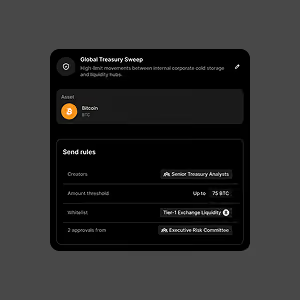
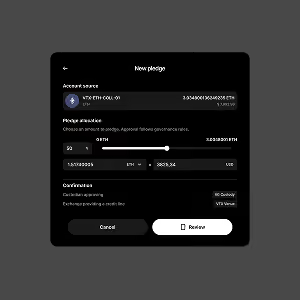
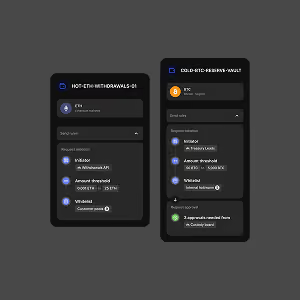
Ledger Enterprise is built around those requirements. A Hardware Security Module architecture keeps private keys isolated, while Personal Security Devices enforce governance directly in hardware. The separation is deliberate: Administrators define the rules, Operators execute within them, and neither role can override the other. Governance is not a policy document. It is enforced on every transaction.
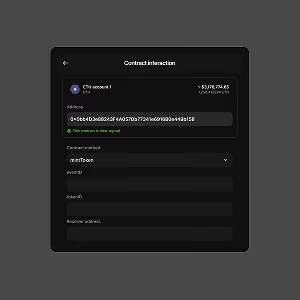
Verification is where institutional risk concentrates. In 2025, Bybit lost over a billion dollars to a single contract substitution that went undetected because the signers could not read what they were approving. Clear Signing solves that. Transaction details are displayed in human-readable language on a secure screen that cannot be tampered with, so what institutions see is exactly what they sign.
This is the infrastructure layer that makes Ethereum Institutional's mission actionable. Coordination brings institutions to the table. Custody, governance, and verification give them the confidence to stay.
From Clear Signing to Ethereum Institutional
Ledger support for Ethereum Institutional is consistent with a longer pattern of investment in the Ethereum ecosystem. In 2023, Ledger launched Clear Signing as an open-source initiative to address one of crypto's most persistent structural risks: the inability of users to read and verify transactions before approving them. In May 2026, Ledger passed stewardship of Clear Signing to the Ethereum Foundation, where it now lives as a neutral, community-governed standard under the Trillion Dollar Security Initiative.
Supporting Ethereum Institutional reflects the ideal that the infrastructure Ledger has spent a decade building belongs in a broader ecosystem effort, one where institutions have the coordination, the tools, and the counterparties they need to participate with confidence.
The work of making Ethereum institutional-grade is a shared one. The role of Ledger is to ensure the security layer is in place when institutions arrive.
Ledger and Ethereum: Building the Foundation Together
Institutional adoption of Ethereum is a coordination problem as much as a technology problem. Ethereum Institutional addresses the former. Ledger Enterprise addresses the latter. Together, they represent what it actually takes to move institutions from evaluation to deployment: a credible, neutral counterpart to navigate the ecosystem, and proven infrastructure to operate within it securely.
To learn more about Ethereum Institutional and the coalition forming around its mission, visit ethereuminstitutional.org. To explore how Ledger Enterprise can support your institution's digital asset strategy, visit enterprise.ledger.com.

.png)
.png)